Exhibitions
End
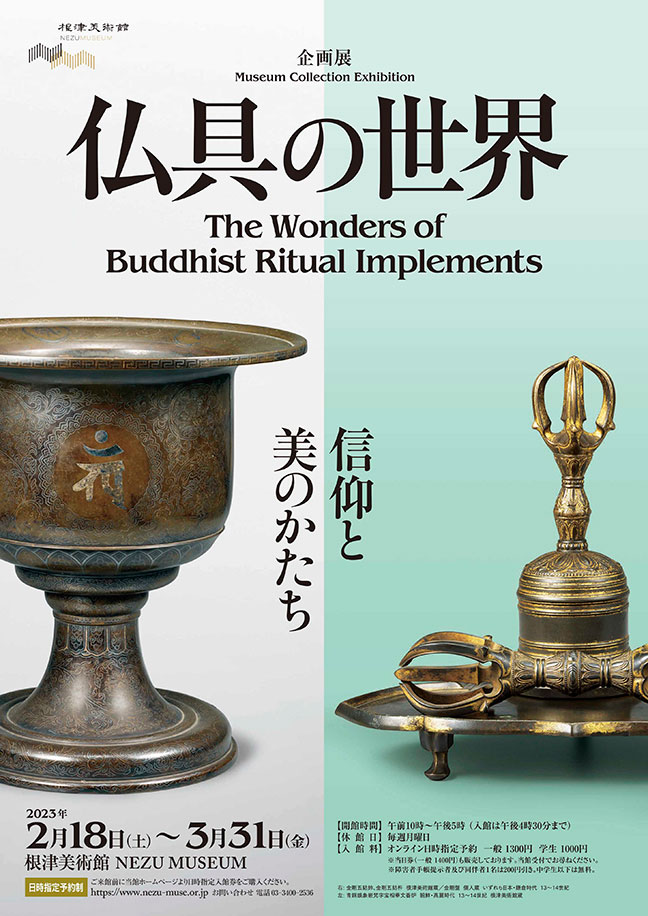
Museum Collection Exhibition
The Wonders of Buddhist Ritual Implements
Saturday, Feburary 18 – Friday, March 31, 2023
Overview
| Dates | Saturday, Feburary 18 – Friday, March 31, 2023 | |
|---|---|---|
| Closed | Mondays | |
| Hours | 10 a.m. - 5 p.m.(last entry: 4:30 p.m.) | |
| General admission (On-line timed-entry tickets) | Adult 1300 yen, Student 1000 yen | |
| Gallery | 1/2 | |
Buddhist ritual implements are essential equipment for solemnly adorning the Buddha, holding memorial services, and mastering the Buddhist teachings. Their range is wide and diverse: from temple ornaments to priests’ daily necessities. These ritual implements’ forms are designed to be suitable for practicing Buddhism, but in them we can also discover aesthetic qualities. This exhibition introduces ritual implements, primarily from our collection, used in a variety of settings and explores the relationships between the Buddhist teachings and Buddhist ritual implements’ sculptural beauty.
Through the forms of Buddhist implements, visitors will become aware of the spirit of adorning and holding services for the Buddha, of seeking to ascertain the truth and of giving, the spirit that bestows all that is good and beautiful. We hope this exhibition will be an opportunity to give thought to the ideas that people put into practice through the Buddhist teachings, in many ways.
Gallery Exhibits
- Important Cultural Property
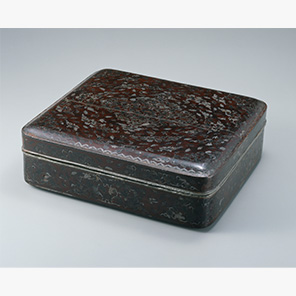
Box with Floral Scroll Design for Priest's Vestment
This box, entirely coated in black lacquer, has been handed down in our museum as a container for a priest’s vestments. Thin sheets of silver, cut out in the shapes of motifs, have been glued to the outside of the box. After lacquer was applied to stabilize it, the lacquer covering the motifs was stripped off. The strongly symmetrical composition, with the hōsōge or “precious flower” as its motif, is filled with the ambience of a time previous to its creation, the Nara period (710-794).
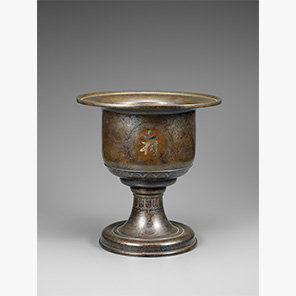
Incense Burner with Sanskrit Characters and Floral Design
This tall footed incense burner was made on the Korean Peninsula during the Goryeo period (918-1392). Thin sheets of silver were cut into Sanskrit characters and imbedded at four places on the incense burner’s sides and six on its rim. The elegant floral scroll patterns that surround them have been created through silver line engraving. Offerings of incense before the Buddha, as well as offerings of flowers or candles, were highly valued.
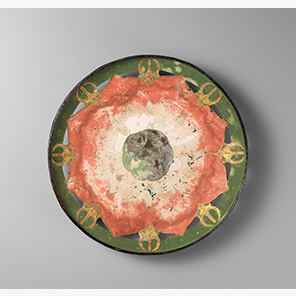
Keko (Flower Petal Basket)
This basket was designed to be filled with artificial flower petals for the rite of scattering flowers. Formed of layers of paper glued together, it has been entirely coated in black lacquer. Gofun (a white pigment made by pulverizing shells) was applied to prepare a base, which was then colored with verdigris green and vermillion red pigments and gold leaf. Three-pronged vajra pestles are placed between the petals of the eight-petaled lotus motif. A similar keko, a National Important Cultural Property, is in the collection of Mantokuji Temple in Aichi prefecture.
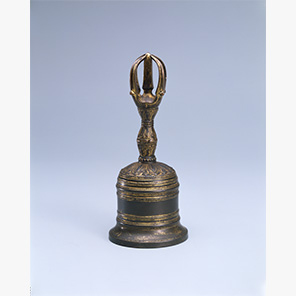
Bell with a Five-Pronged End
This bell has five prongs at the top of the handle. Beneath the prongs, the handle has a protuberance between two levels of a lotus petal design made by overlapping three lotus petals at each level. This type of bell was an esoteric Buddhist ritual implement. Its sound summons the Buddha-nature that is inherent in all human beings.
- TOP
- Exhibitions
- The Wonders of Buddhist Ritual Implements