
Exhibitions
End
Special Exhibition
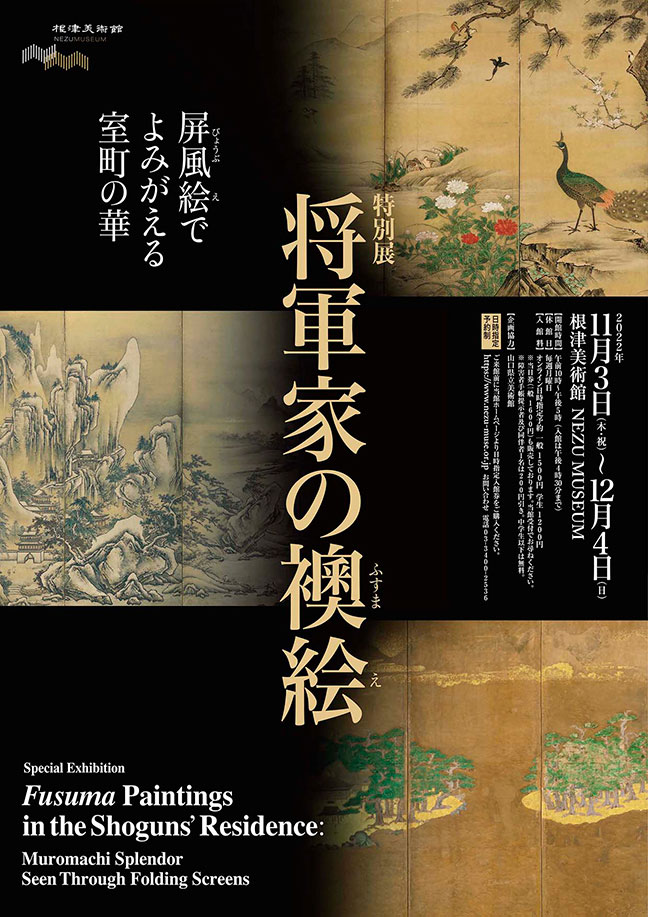
Fusuma Paintings in the Shoguns’ Residence Muromachi Splendor Seen Through Folding Screens
Thursday, November 3 – Sunday, December 4, 2022
Overview
| Dates | Thursday, November 3 – Sunday, December 4, 2022 | |
|---|---|---|
| Closed | Mondays | |
| Hours | 10 a.m. - 5 p.m.(last entry: 4:30 p.m.) | |
| General admission (On-line timed-entry tickets) | Adult 1500 yen, Student 1200 yen | |
| Gallery | 1/2 | |
The Muromachi period (1336-1573) was the point of origin for contemporary Japanese culture. At the center of Muromachi culture were the residences of the Ashikaga shoguns, rulers of the Muromachi shogunate, in Kyoto.
A particularly important structure in the shoguns' residences was the kaisho, where people gathered and its fusuma sliding doors were adorned with paintings by the leading artists of their time. Sadly, all those fusuma paintings have been lost. Our eyes will never see them. We do know, however, what the subjects of those paintings were, thanks to descriptions in surviving texts. Also, extant folding screen paintings that are extremely similar to the fusuma paintings in size and format make it possible to imagine them, restoring them in our minds.
This exhibition recreates the world of Fusuma Paintings in the Shoguns' Residence, by selecting classic subjects used in the fusuma paintings in the kaisho of the Ashikaga shoguns’ residences, gathering folding screen paintings on those subjects from the latter half of the Muromachi through the Edo periods, from the fifteenth through the nineteenth centuries, and displaying them as a group.
Gallery Exhibits
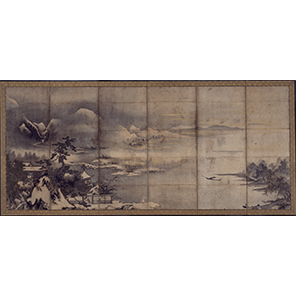
- Important Cultural Property
Landscape in the Four Seasons
Attributed to Tenshō Shūbun
This composition, in which rock masses, pine trees, and pavilions are the central elements, is modeled on the work of Son Junze, a Yuan-period (1271 to 1368) Chinese artist. The impressive use of dark sumi ink and the mokkotsu technique are characteristics also seen in paintings by Sesshū and other pupils of Shūbun. It is highly likely that this landscape is by Shūbun, a legendary master of ink-wash painting.
*On display only from November 22 to December 4.
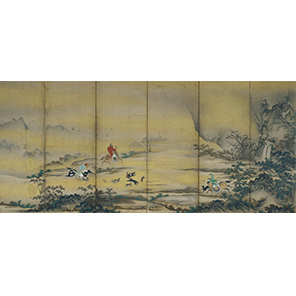
Tartars Hunting
By Shikibu Terutada
These screens depict a hunt by equestrian people who lived on the Mongolian plains in northern China. That subject is thought to have been chosen for a fusuma painting because the hunting motif expresses a warrior’s identity.
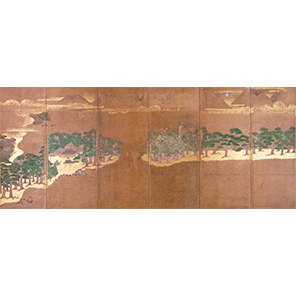
Scenes of Suma and Amanohashidate
The fusuma paintings for the Shogun’s residence included Yamato-e paintings of famous places in Japan. Those paintings attempted to capture the world of waka poetry, which underlies the concept of famous places. Poetry was not, however, the only inspiration. The kaisho of Yoshinori and Yoshimasa, the sixth and eighth shoguns, also had depictions of Amanohashidate, probably because the third shogun, Yoshimitsu, had loved that place.
- Important Cultural Property
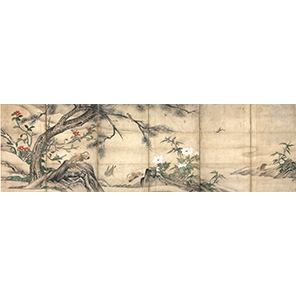
Birds and Flowers of the Four Seasons
By Geiai
The bird-and-flower fusuma paintings in Yoshimasa’s Higashiyama residence were in the style of Ma Yuan (n.d.), a Southern Song academy painter. They also emulated bird-and-flower paintings by Shūbun. Geiai, who painted these screens, had a connection with Sōtan, an artist by appointment to Yoshimasa.
*On display only from November 3 to November 20.
- TOP
- Exhibitions
- Fusuma Paintings in the Shoguns’ Residence