Exhibitions
End
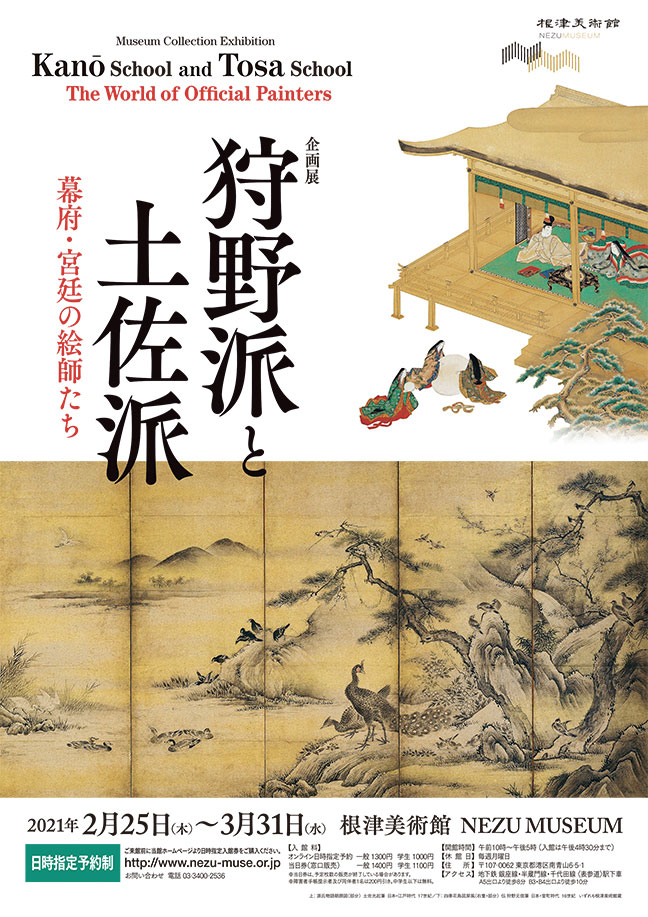
Museum Collection Exhibition
Kanō School and Tosa School The World of Official Painters
Thursday, February 25 - Wednesday, March 31, 2021
Overview
| Dates | Thursday, February 25 - Wednesday, March 31, 2021 | |
|---|---|---|
| Closed | Mondays | |
| Hours | 10 a.m. - 5 p.m.(last entry: 4:30 p.m.) | |
| General admission (On-line timed-entry tickets) | Timed-entry ticket (online) : Adult 1300 yen, Student 1000 yen Same-day ticket (at the door) : Adult 1400 yen, Student 1100 yen | |
| Gallery | 1/2 | |
The Kanō school’s long rule over the art world in Japan lasted four centuries. That school’s founding father, Kanō Masanobu (1434?–1530) distinguished himself as an artist producing Chinese-style paintings during the Muromachi period (1336–1573), laying the foundations for what would become that school. At the same time period, the achievements of Tosa Mitsunobu (1434?–1525) were raising the Tosa school, a group of artists working in Yamato-e, a traditional style of Japanese painting, to new heights. The Kanō school went on to dominate art circles in Japan, but the Tosa school lived on unbroken over the generations, and achieved a remarkable revival in the first half of the Edo period (1615-1868), when Tosa artists served the imperial court.
This exhibition focuses on Kanō and Tosa school works in the museum collection to present the work of artists serving the shogunate and the imperial court in the Muromachi and Edo periods.
Gallery Exhibits
- Painting
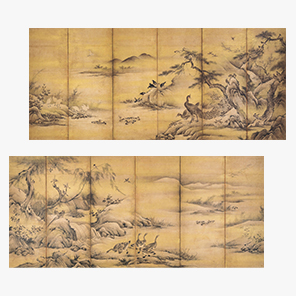
Birds and Flowers in the Four Seasons
Attributed to Kanō Motonobu
This pair of folding screens, with a variety of birds and flowers arranged in a space with a profound sense of depth, is attributed to Kanō Motonobu (1476?-1559). The lucid compositions and painting techniques that Motonobu established were well received by the men then in power, enabling the Kanō school to conquer the world of art.
- Painting
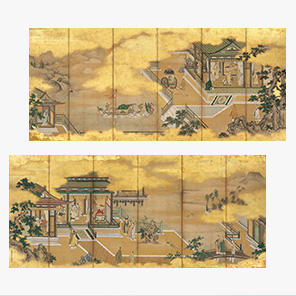
Two Chinese Emperors
By Kanō Tan'yū
Kanō Tan’yū (1602-1674), who reigned at the top of the art world, created these folding screen paintings, which depict two legendary Chinese emperors. These gorgeous picture planes are truly suited for adorning the residence or castle of a powerful person.
- Painting
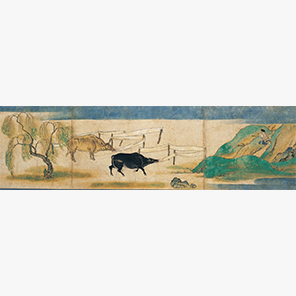
The Tale of Toad
Attributed to Tosa Mitsunobu
This handscroll depicts an otogi-zōshi, a popular tale of a liar who comes up in the world by becoming the son-in-law of a wealthy man. The pure, clear colors and deft depiction carry on the style of Tosa Mitsunobu (1434?–1525), who reached the ultimate in eminence as a Yamato-e painter.
- Painting
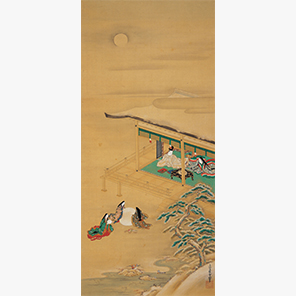
Scene from the "Asagao" Chapter of The Tale of Genji
By Tosa Mitsuoki
The artist Tosa Mitsuoki (1617-1691) fostered a revival of the Tosa school by incorporating new styles in traditional Yamato-e paintings. For the first time in eighty-five years, a Tosa school artist became the head painter in the imperial court’s official painting atelier. This painting, in which he has depicted a famous scene from The Tale of Genji, displays the gorgeous colors and detailed depiction that define Mitsuoki’s superb artistic abilities.
- TOP
- Exhibitions
- Kanō School and Tosa School