Exhibitions
End
Museum Collection Exhibition
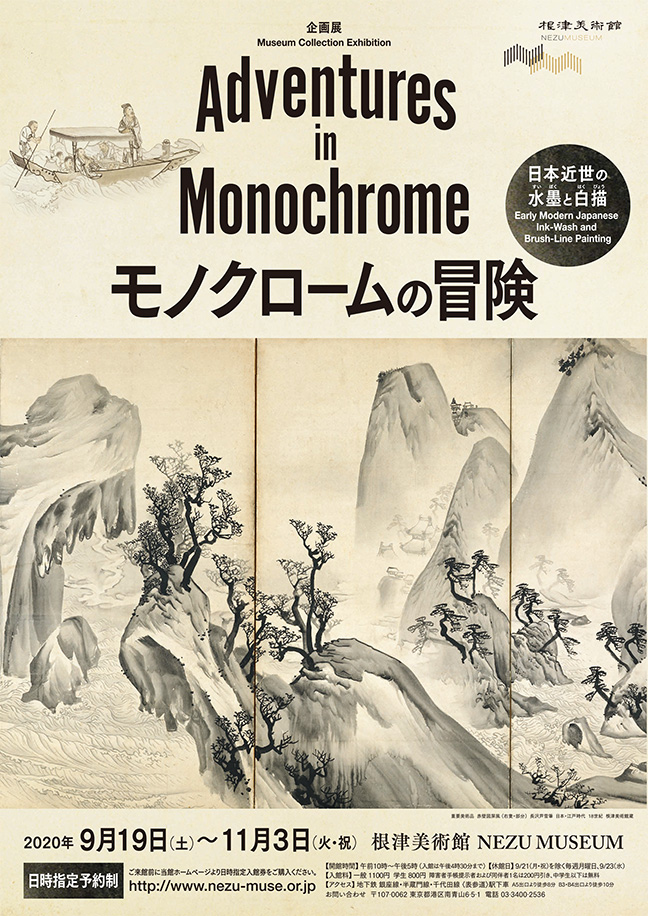
Adventures in Monochrome Early Modern Japanese Ink-Wash and Brush-Line Painting
Saturday, September 19 - Tuesday, November 3、2020
Overview
| Dates | Saturday, September 19 - Tuesday, November 3、2020 | |
|---|---|---|
| Closed | Mondays | |
| Hours | 10 a.m. - 5 p.m.(last entry: 4:30 p.m.) | |
| General admission (On-line timed-entry tickets) | Adult 1100 yen, Student 900 yen | |
| Gallery | 1/2 | |
In East Asia, sumi ink, the primary medium for writing, has continued also to be the most important medium for painting, which developed in close association with calligraphy. Paintings created in sumi are of two main types. Ink-wash paintings use gradations, blurring, and modulated lines. In contrast, brush-line paintings use primarily thin, uniform lines.
In this exhibition of early modern works from Japan, we explore the creative potential of sumi ink in fascinating examples of both ink-wash and brush-line paintings. These artists compete to display their individuality in cleverly devised uses of ink wash or invite the viewer to a tranquil terrain created with stoic brush-line painting.
Gallery Exhibits

- Important Art Object
Red Cliff (Detail) By Nagasawa Rosetsu
In this immense painting, we see the Chinese poet Su Shi enjoying scenic spots along the Yangtze River. In it we savor the extraordinary ink-wash techniques of Nagasawa Rosetsu (1754-99), who, while the leading disciple of Maruyama Ōkyo, was an individualist unconstrained by the standard forms he was taught.
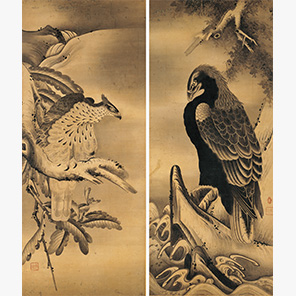
Eagle and Hawk By Soga Sōan
The effective use of ink-wash painting, with its lively modulations, and the dramatic style make these depictions of an eagle and a hawk utterly eye-catching. We know little about this painter other than his name, Soga Sōan, which suggests he was a member of the Soga school. That school, which originated in the Momoyama period (1568-98), excelled at depictions of hawks.
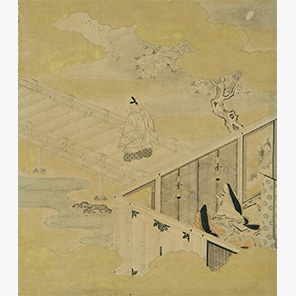
Scenes from The Tale of Genji (Detail) Attributed to Sumiyoshi Gukei
This work is a page from a set of paintings on poem cards depicting famous scenes from The Tale of Genji that have been made into an album. The use of thin ink lines brings a refined elegance to the world depicted in this small image. While called monochromes, such works often had color and gold applied here and there.
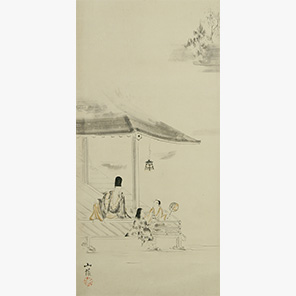
Enjoying the Cool in Summer (Detail) By Reizei Tametaka
The three individuals refreshing themselves at a pavilion built over a spring may be a father and his children. In this painting by Reizei Tametaka (1823-64), a member of the Yamato-e Revival school, the uniform lines of ink that are the essence of brush-line painting add elegant movement and nuance.
- TOP
- Exhibitions
- Adventures in Monochrome