Exhibitions
End
Museum Collection Exhibition
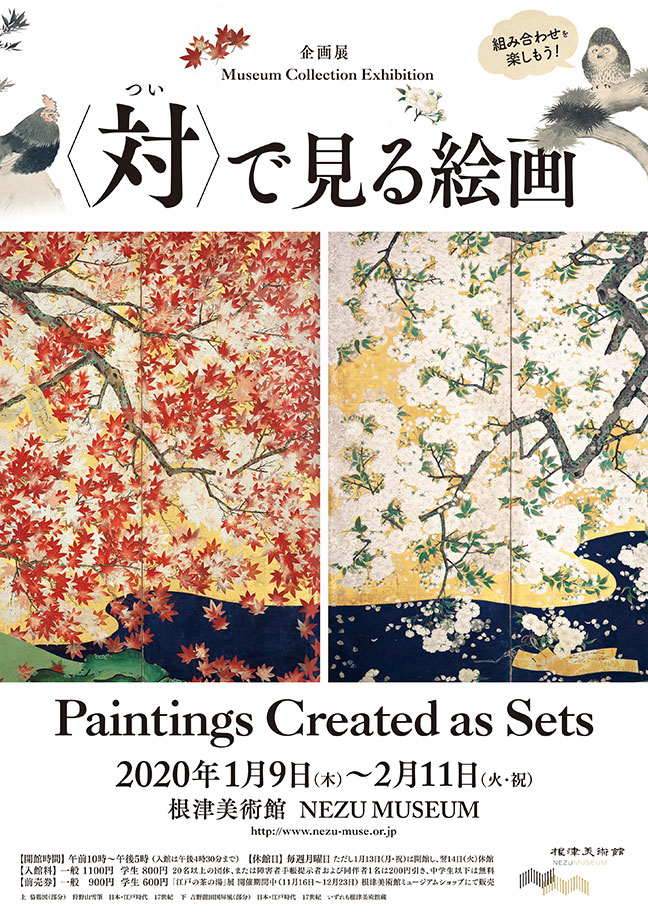
Paintings Created as Sets
Thursday, January 9 - Tuesday, February 11, 2020
Overview
| Dates | Thursday, January 9 - Tuesday, February 11, 2020 | |
|---|---|---|
| Closed | Mondays, except January 13, and closed on January 14 | |
| Hours | 10 a.m. - 5 p.m.(last entry: 4:30 p.m.) | |
| General admission (On-line timed-entry tickets) | Adult 1100 yen, Student 900 yen | |
| Gallery | 1/2 | |
Paintings created in the form of sets are common in East Asian painting. Examples include sets of hanging scrolls, most commonly diptychs or triptychs, and pairs of folding screens, made of left- and right-hand screens. With sets of hanging scrolls, the group can be appreciated as a whole, the individual scrolls can be enjoyed separately, and they can be recombined in a differed order for yet another effect. That is why, in the course of handing down these works of art, what had started as a set of four scrolls might be divided into two sets of two and why works created separately may be combined to form new sets.
This exhibition explores the fascination of paintings as sets from many perspectives, including the connectivity and individuality of each painting, sets’ intriguing contrasts, and their integration. As you savor them, please note that, like paintings, the sword fittings on display also have sets of designs.
Gallery Exhibits
- Painting
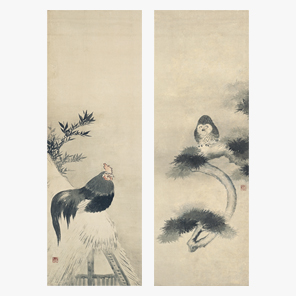
Owl and Rooster
By Kanō Sansetsu
A nocturnal bird (an owl) perches on the dramatically bent branch of a pine tree. A rooster, announcing the breaking of day, stands atop a roof that is presented at an angle, with bamboo in the background. The depiction of each bird’s eyes is intriguing. In this pair of hanging scrolls, the artist has set up a variety of contrasts in composition and motif to accentuate their relationship as a set. .
- Painting
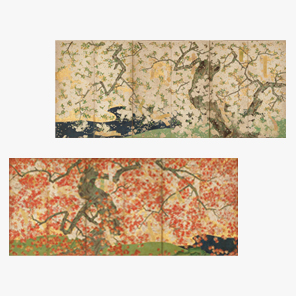
Cherry Blossoms in Yoshino and Maple Leaves in Tatsuta
In the right-hand screen, a venerable cherry tree is in full bloom, its broad branches filling the picture plane. A large maple tree, its autumn foliage as brilliant as brocade, is presented in the left-hand screen. Classic waka poems about cherry blossoms and autumn leaves are written on the poem slips hanging from their branches. Spring and fall, Yoshino and Tatsuta: the seasons and famous places are contrasted.
- Painting
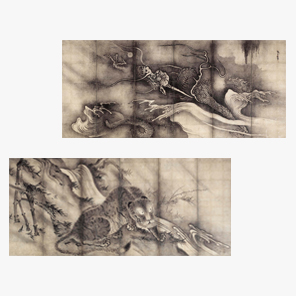
Dragon and Tiger
The dragon and tiger, who are responsible for east and west, are two of the four sacred beasts guarding the four cardinal directions. Here they are likened to two rivals equally matched in power. A favorite among Sengoku period (1467-1600) warriors and Zen priests, this pairing was often depicted in hanging scrolls diptychs and pairs of folding screens.
- Painting
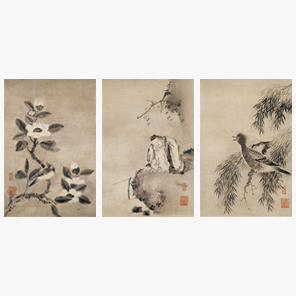
Taigongwang, Flowers and Birds
By Yōgetsu
A triptych with the figure of a Buddha, immortal, or legendary human in the central hanging scroll and bird-and-flower and landscape paintings on the left and right is a uniquely Japanese format that flourished from the Muromachi period (1336-1573) on. It is thought to be based on paintings of Buddhist triads, which present a Buddha and attendants.
- TOP
- Exhibitions
- Paintings Created as Sets