Exhibitions
End
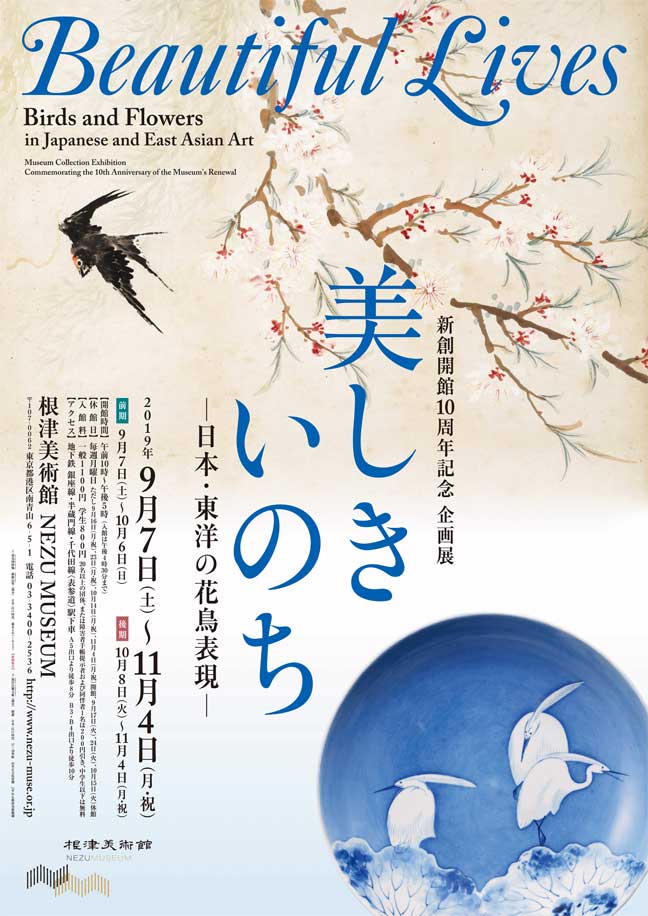
Museum Collection Exhibition Commemorating the 10th Anniversary of the Museum’s Renewal
Beautiful Lives Birds and Flowers in Japanese and East Asian Art
Saturday, September 7 - Monday, November 4, 2019
Overview
| Dates | Saturday, September 7 - Monday, November 4, 2019 | |
|---|---|---|
| Closed | Mondays, except September 16, 23, October 14, November 4, and closed on September 17, 24, October 15 | |
| Hours | 10 a.m. - 5 p.m.(last entry: 4:30 p.m.) | |
| General admission (On-line timed-entry tickets) | Adult 1300 yen, Student 1000 yen | |
| Gallery | 1/2 | |
Flowers, with their countless colors and shapes, and birds, with their gorgeous feathers, have been objects of appreciation throughout the world from time immemorial. In East Asia, and chiefly in China, bird-and-flower paintings became as important a genre as figure and landscape paintings. The Japanese term shasei, now used to mean sketching from life, was originally used in China, where bird-and-flower painting originated, to refer to the practice of observing the subject and depicting its form, ecology, and vital nature. Bird-and-flower painting, then, takes beautiful flora and fauna as its motif in capturing the brilliant radiance of life itself.
In this exhibition, we trace the history and stylistic evolution of bird-and-flower paintings in East Asia, particularly China and Japan, where their motifs sometimes call up images of alien lands or paradises, are garbed in auspicious implications, or are used in craft designs.
Note:
All the paintings will be replaced (or the sections of scrolls on display changed) between the 1st Period (Saturday, September 7, to Sunday, October 6) and the 2nd Period (Tuesday, October 8, to Monday, a holiday, November 4). Mirrors and ceramics will remain on display throughout the exhibition period.
Gallery Exhibits
- Painting
- National Treasure
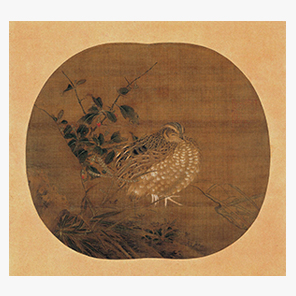
Quail
Attributed to Li Anzhong
This small picture plane, on which a quail is depicted walking in a field, has a rich sense of mass and motion. Its transcendental brushwork even distinguishes between the textures of the stiff, glossy feathers on the quail’s wings and the soft, white feathers on its chest. Bird-and-flower paintings produced at the Song Dynasty’s Imperial Painting Academy demand that the viewer have the ability truly to see the painting. [1st Period]
- Painting
- Important Cultural Property
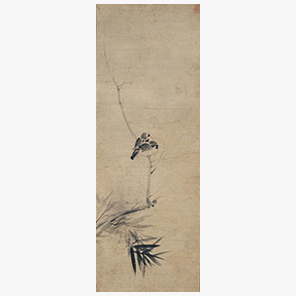
Sparrows on BambooBay (detail)
Attributed to Muqi
Two sparrows have perched on a withered branch. Their wings are depicted with light and dark shades of ink wash, the belly with exterior shading in pale ink to create an accurate sense of form and volume. The blurring of the ink creates an almost drippingly wet effect. This painting is attributed to Muqi, a Chinese artist who was a major influence on ink painting in Japan. [2nd Period]
- Ceramics
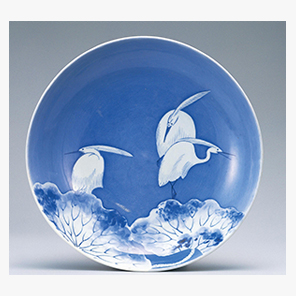
Dish with Heron Design
Hizen ware, nabeshima type
White herons on withered lotus leaves are drawn in cobalt oxide, a blue pigment, in flowing strokes. No flowers are in bloom, but this design is part of the water fowl and lotus pond lineage.
- Painting
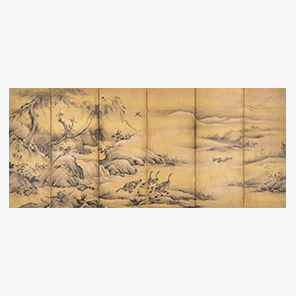
Flowers and Birds in the Four Seasons
Attributed to Kanō Motonobu
(Left screen)
The forms of the birds, the rounded rocks, and the soft use of ink are grounded in Muqi’s style. The construction of space to give a sense of depth while also letting us perceive the birds’ vitality and the very movement of the air is superb. [1st Period]
- Painting
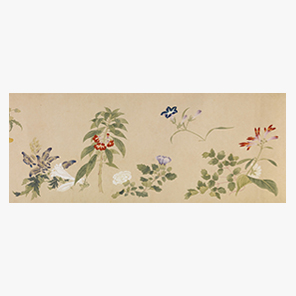
Autumn Flowers
By Qian Weicheng
This handscroll includes paintings of thirty varieties of autumn flowers. It carries on the style of Yun Shouping, a Qing dynasty artist who attained great success in 17th century with his fascinating paintings of flowering plants. The artist, Qian Weicheng (1720-72) was an imperial court painter during the reign of the Qianlong Emperor. Such works also influenced Japanese paintings in the latter half of the Edo period, from the eighteenth to the nineteenth centuries.
- Painting
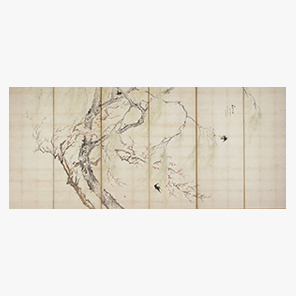
Birds and Flowers
By Tsubaki Chinzan
(Right screen)
This work, which depicts peach and willow trees with four swallows flying about, is the right-hand screen from a pair of six-panel folding screens. The pale colors added to the supple ink painting are impressive. In combination with the dynamic composition, the colors and brushwork result in a picture plane filled with vitality. The artist is Tsubaki Chinzan (1801-54), who admired the Qing-dynasty painter Yun Shouping. [2nd Period]
- TOP
- Exhibitions
- Beautiful Lives