Exhibitions
End
Museum Collection Exhibition
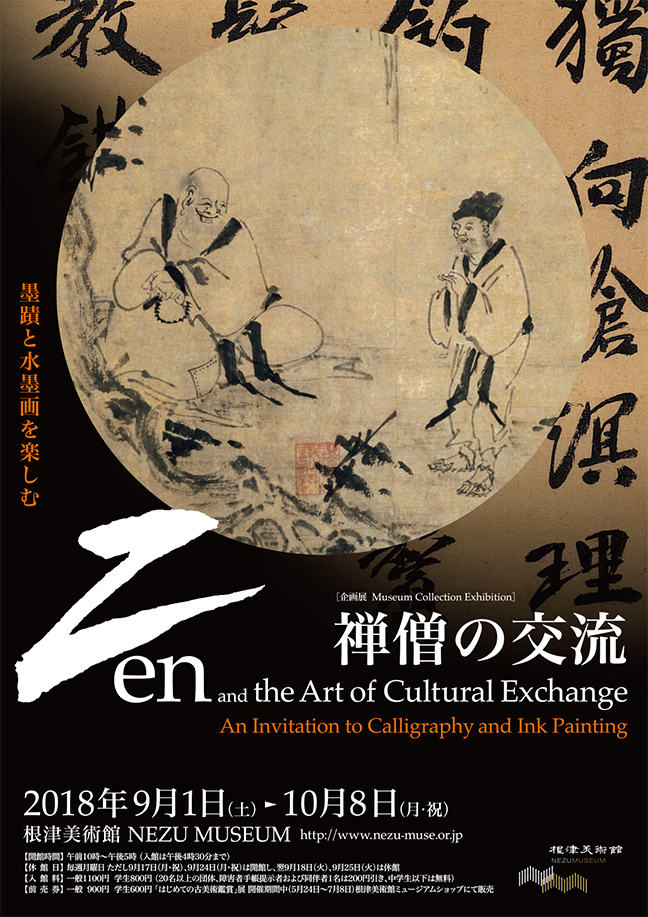
Zen and the Art of Cultural Exchange: An Invitation to Calligraphy and Ink Painting
Saturday, September 1 - Monday, October 8, 2018
Overview
| Dates | Saturday, September 1 - Monday, October 8, 2018 | |
|---|---|---|
| Closed | Mondays (except for 9/17, 24, 10/8), 9/18 and 9/25 | |
| Hours | 10 am to 5 pm(Entrance closes 30 min. before closing) | |
| General admission (On-line timed-entry tickets) | Adult 1100 yen, Student 800 yen | |
| Gallery | 1/2 | |
During the Middle Ages, Buddhist monks from Japan and China crossed the seas on merchant vessels and built close relationships with each other. The highly individual writings of Zen Buddhist monks, and especially those handed down from master to disciple, tell us much about those relationships. Zen monks in Japan, inspired by their Chinese counterparts, gathered in literati circles. In those circles, they appreciated and critiqued paintings and added poetic inscriptions to them, giving rise to magnificent works combining poetry and painting. Some Zen monks, such as the renowned Sesshū, became specialists in painting.
This exhibition introduces a variety of writings and ink paintings born of the exchanges cultivated by Zen monks.
Gallery Exhibits
- Painting
- National Treasure
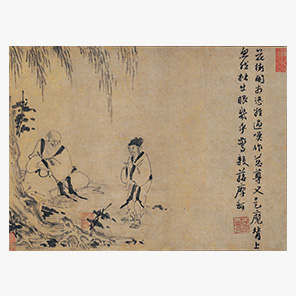
Budai and Jiang Mohe in Discussion on Buddhism
By Yintuoluo, with Inscription by Chushi Fanqi
This work depicts the scene of a discussion in which Jiang Mahe became certain one day that the monk Budai was an incarnation of Maitreya, the future Buddha. This painting, with its distinctive style, making effective use of dark and light shades of sumi ink, is by Yintuoluo, who was also a Zen monk in China. Chushi Fanqi, who contributed the poetic inscription, was also a Chinese Zen monk , one who became highly influential in China and in other countries.
- Calligraphy
- Important Cultural Property
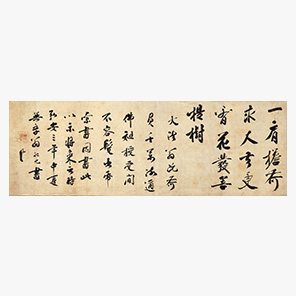
Religious Verse
By Wuxue Zuyuan
The Chinese monk Wuxue Zuyuan was invited to Japan by Hōjō Tokimune, Regent of the Kamakura Shogunate. He served as head priest of Kenchō-ji Temple and first abbot of Engaku-ji Temple in Kamakura. This work is religious verse that Wuxue composed upon presenting to Ichi’o Ingō, head priest of Chōraku-ji Temple in Kōzuke (in today’s Gunma prefecture), his Buddhist robe as evidence that Ichi’o Ingō, having received transmission of the teachings, was his Dharma successor.
- Painting
- Important Cultural Property
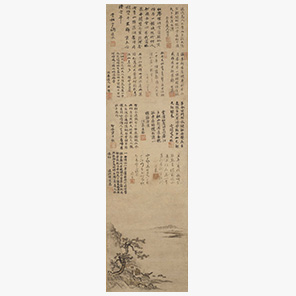
Landscape, known as Kōten-en'i
By Shūbun, with inscriptions by twelve priests including Daigaku Shūsū
A hanging scroll composed of both poetry and painting is known as a shiga-jiku (poem-picture scroll). A group of twelve Zen monks, including Daigaku Shūsū, studied this painting and contributed verses to it. The subject is a solitary, humble thatched hut standing by the waterside in a peaceful mountain valley. The painting depicts what was to those Zen monks, based on the concept of reclusion, an ideal landscape where one could live apart from the mundane world.
- Calligraphy
- Important Cultural Property
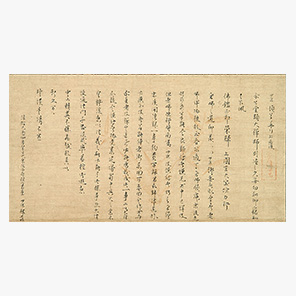
Letter
By Jiammen Miaosten
This letter was written by the Chinese monk Jiammen Miaosten to his fellow disciple Enni, founder of Tōfuku-ji Temple in Kyoto. It tells of the death of Wuzhun Shifan, who was their master, and his last will. From it we can infer that Enni maintained ties with his master and fellow disciples in China after returning to Japan.
- TOP
- Exhibitions
- Zen and the Art of Cultural Exchange: An Invitation to Calligraphy and Ink Painting