Exhibitions
End
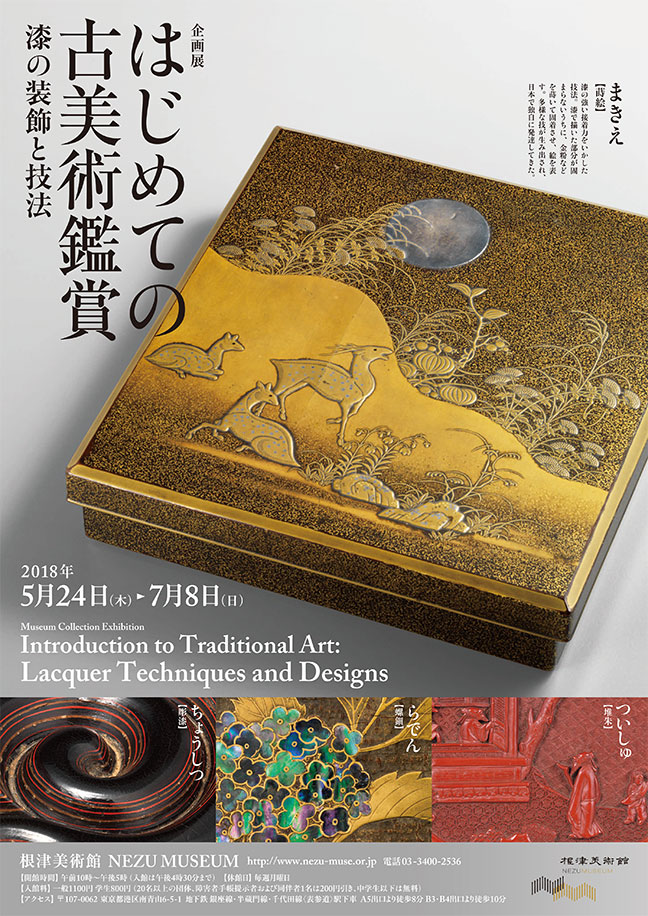
Museum Collection Exhibition
Introduction to Traditional Art:
Lacquer Techniques and Designs
Thursday, May 24 - Sunday, July 8, 2018
Overview
| Dates | Thursday, May 24 - Sunday, July 8, 2018 | |
|---|---|---|
| Closed | Mondays | |
| Hours | 10 am to 5 pm(Entrance closes 30 min. before closing) | |
| General admission (On-line timed-entry tickets) | Adult 1100 yen, Student 800 yen | |
| Gallery | 1/2 | |
Lacquer, urushi in Japanese, has been used since ancient times as a coating for implements and furniture used in daily life in Japan. The use of maki-e techniques to decorate lacquerware with gold began in Japan when beautifully decorated lacquerware was introduced from China during the eighth century. Maki-e lacquerware has developed into one of Japan’s iconic craft arts and is renowned worldwide.
From the middle ages on, a related tradition developed of holding lacquerware from China and the Korean peninsula (known collectively as karamono lacquerware) in particularly high regard. Rare and precious examples of karamono made using techniques such as raden mother-of-pearl inlay, chōshitsu carved lacquer, and zonsei colored lacquer now, moreover, survive only in Japan.
This exhibition provides straightforward explanations of the history, techniques, and designs of Japanese, Chinese, and Korean-peninsula lacquerware. We hope visitors will enjoy this opportunity to deepen their understanding of Japan’s rich lacquerware tradition.
Gallery Exhibits
- Lacquer
- Important Cultural Property
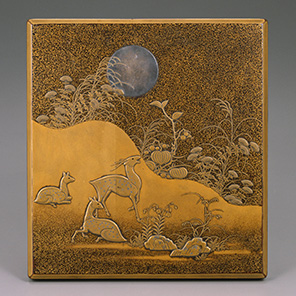
Writing Box with Deer in Autumn Landscape, known as Kasugayama
Maki-e lacquer on wood
Maki-e: This technique makes use of lacquer’s strong adhesive properties. Lacquer is painted on a part of the work, and, before it dries, powdered gold or other metals are sprinkled on it, where it sticks, creating a picture. Many unique variations of the maki-e technique originated in Japan.
- Lacquer
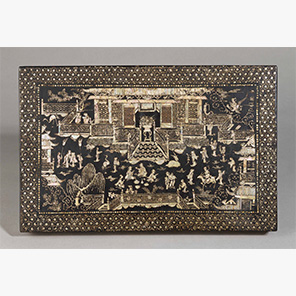
Box with Pavilion and Figure Design
Wood, lacquer with mother-of-pearl inlay
Raden: In mother-of-pearl inlaid lacquerware, pieces of the pearly interior of turban shells or other shells are cut into small pieces and applied to or inlaid in the surface of the piece. Lacquer is then applied and polished to complete the decoration. Raden originated in China, reached Japan in the eighth century. Many examples in which raden was combined with the maki-e technique survive from the twelfth century.
- Lacquer
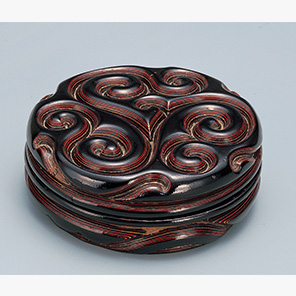
Box with Guri Design
Carved lacquer on wood
Chōshitsu: To create carved lacquer, layers of lacquer in several colors are thickly applied to a ceramic, metal, or wooden base. The design is then engraved into them. Two common types are tsuishu and tsuikoku, in which cinnabar red or black lacquer is applied and carved.
- Lacquer
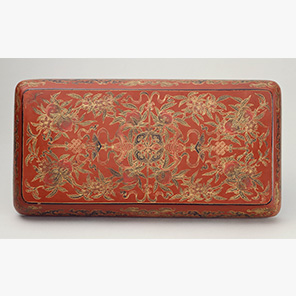
Rectangular Box with Fruit Branches Design
Wood, carved polychrome lacquer
Zonsei: The motif is engraved into multiple layers of colored lacquer, and then filled in with lacquer of another color. Gold is used to define the outlines of the motif.
- TOP
- Exhibitions
- Introduction to Traditional Art:
Lacquer Techniques and Designs