Exhibitions
End
Museum Collection Exhibition
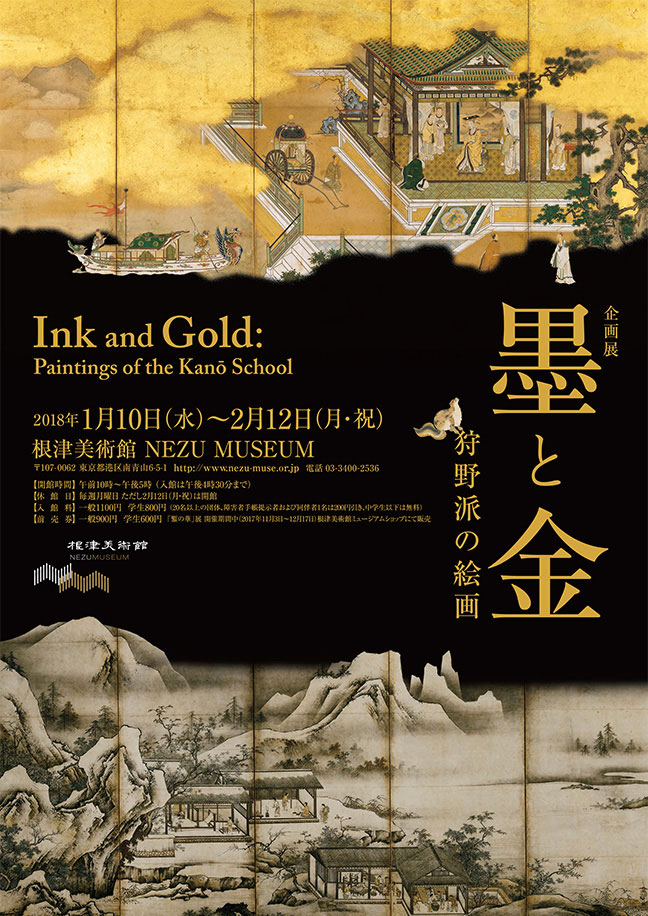
Ink and Gold: Paintings of the Kanō School
Wednesday, January 10 - Monday, February 12, 2018
Overview
| Dates | Wednesday, January 10 - Monday, February 12, 2018 | |
|---|---|---|
| Closed | Mondays, except February 12 | |
| Hours | 10 am to 5 pm(Entrance closes 30 min. before closing) | |
| General admission (On-line timed-entry tickets) | Adult 1100 yen, Student 800 yen | |
| Gallery | 1and 2 | |
The Kanō school rose to prominence in the fifteenth century, during the Muromachi period, when Kanō artists served the Ashikaga shoguns. Oda Nobunaga and Toyotomi Hideyoshi both admired their work, and Tokugawa Ieyasu made the head of the Kanō school painter by appointment to the shogunate. Throughout the Edo period, with a government that valued social order, the Kanō school remained supreme in the world of painting in Japan.
The Kanō conquest of the art world was due to its almighty style, which integrated a variety of earlier techniques. The foundation was Chinese ink painting, but the Kanō categorized ink painting styles based on the work of Chinese artists to create clearcut kata or hallmark styles. In order to expand its repertoire, the Kanō school also incorporated color techniques from Yamato-e and made lavish use of gold on folding screens.
Our “Ink and Gold” title points visitors to the central themes of this exhibition: the revolutionary and bountiful beauty of Kanō school paintings.
Gallery Exhibits
- Painting
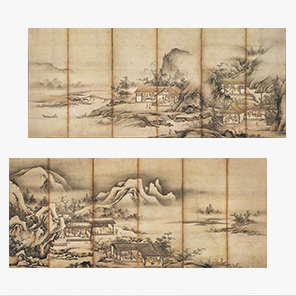
Sericulture and Weaving
Attributed to Kanō Motonobu
Among these landscapes of the four seasons are thirteen scenes of people at work raising silkworms taken from Chinese paintings of agriculture and sericulture, a genre reserved for court painters. The confident depictions of the landscape, the power of the composition in which multiple scenes are combined, and the strength of the brushwork demonstrate the attainments achieved by Motonobu (?-1559).
- Painting
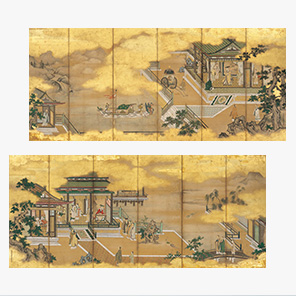
Two Chinese Emperors
By Kanō Tan’yū
This painting depicts two of the mythical five emperors who created Chinese civilization: Huang Di, who invented boats and carts to overcome difficulties in transportation, and Shun, who regulated the empire with the music he played on a stringed instrument. Paintings of these subjects, regarded as paragons of proper government, were sought after by both shoguns and daimyos. Tan’yū (1602-1674) created this highly refined and supremely gorgeous painting.
- Painting
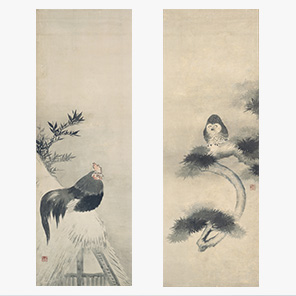
Owl and Rooster
By Kanō Sansetsu
In these scrolls, the owl, active at night, and the rooster, which crows at dawn, are contrasted in their compositions. A very human psychology seems to have been projected on the birds’ eyes. These witty works are by Sansetsu (1590-1651).
- Painting
- Important Cultural Property
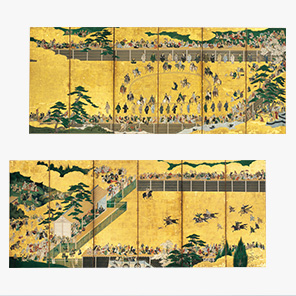
Dog Chase
The dog chase was a competition used to train samurai mounted archers. This work is based on a painting by Sanraku (1559-1635) and appears to be by a Kanō school artist.
- TOP
- Exhibitions
- Ink and Gold: Paintings of the Kanō School