Exhibitions
End
Museum Collection Exhibition
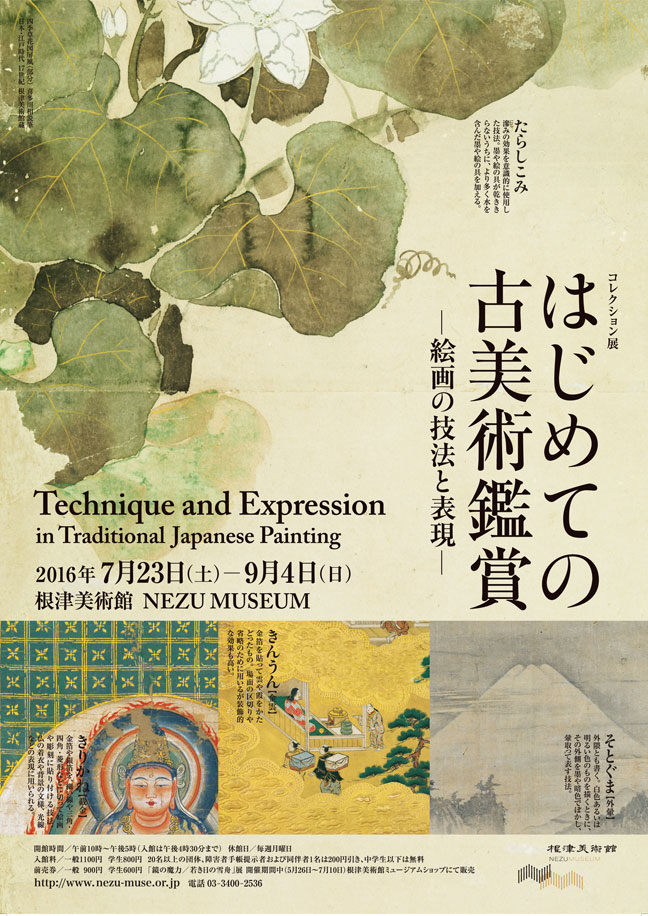
Technique and Expression in Traditional Japanese Painting
July 23, Saturday- September 4, Sunday, 2016
Overview
| Dates | July 23, Saturday- September 4, Sunday, 2016 | |
|---|---|---|
| Closed | Mondays | |
| Hours | 10 am to 5 pm(Entrance closes 30 min. before closing) | |
| General admission (On-line timed-entry tickets) | Adult 1100 yen, Student 800 yen | |
| Gallery | 1/2 | |
We often hear that, compared to Western art, classical Japanese art is inaccessible and its key features difficult to understand. Many people also seem to feel that the technical terminology used in the descriptions of these artworks is unfamiliar and further prevents them from appreciating the works. However, learning these terms expands our ways of seeing and broadens the appeal of the art, making it possible to experience the attraction and wonder of Japanese art all the more deeply.
In this exhibition, we explain the techniques and terminology of Japanese painting simply, with particular focus on techniques involving ink and gold, through examples from the Nezu Museum collection. We hope you enjoy the exhibition and even bring your children to see it over the summer holiday.
In this exhibition, we explain the techniques and terminology of Japanese painting simply, with particular focus on techniques involving ink and gold, through examples from the Nezu Museum collection. We hope you enjoy the exhibition and even bring your children to see it over the summer holiday.
Gallery Exhibits
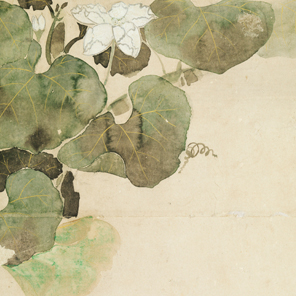
Flowers of Four SeasonsBy Kitagawa Sōsetsu
Tarashikomi (puddling): a technique that deliberately employs a bleeding effect that was particularly favored by Tawaraya Sōtatsu and painters of the Rinpa School. While the ink and pigments have not completely dried, additional wet ink and pigments are dripped onto them to create a complex blurring effect.
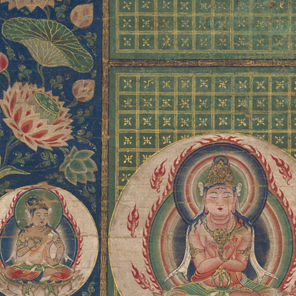
Aizen (Rāgarāja) Mandala
Kirikane (cut gold leaf): a technique involving cutting fine strips as well as triangular, square, and diamond-shaped pieces of gold and/or silver foil and applying them to the surface of paintings and sculptures. This technique was used to render patterns on the clothing and the designs in the background of Buddha images, and to express the glow that emanated from the bodies of Buddha figures. The expression of these meticulous designs required a highly sophisticated level of technical skill.
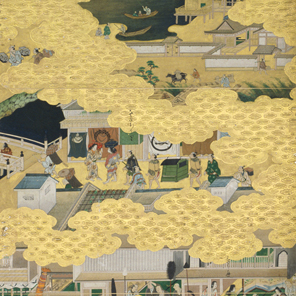
Scenes in and around the Capital Kyoto
Kin’un (gold clouds): creating cloud shapes or mist by applying gold foil. The technique is used to set apart different scenes, but it also has a highly decorative effect. Also called “Genji clouds.”
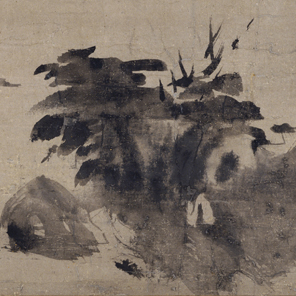
Landscape in Splashed-ink StyleBy Unkei Eii, with inscription by Takuan Sōhō
Hatsuboku (splashed ink): a technique of filling the brush with a large volume of ink to create forms in bold brushwork that appears almost to scatter the ink across the painting. Three-dimensionality is achieved through varying gradations in color of light and dark ink.
- TOP
- Exhibitions
- Technique and Expression in Traditional Japanese Painting