Exhibitions
End
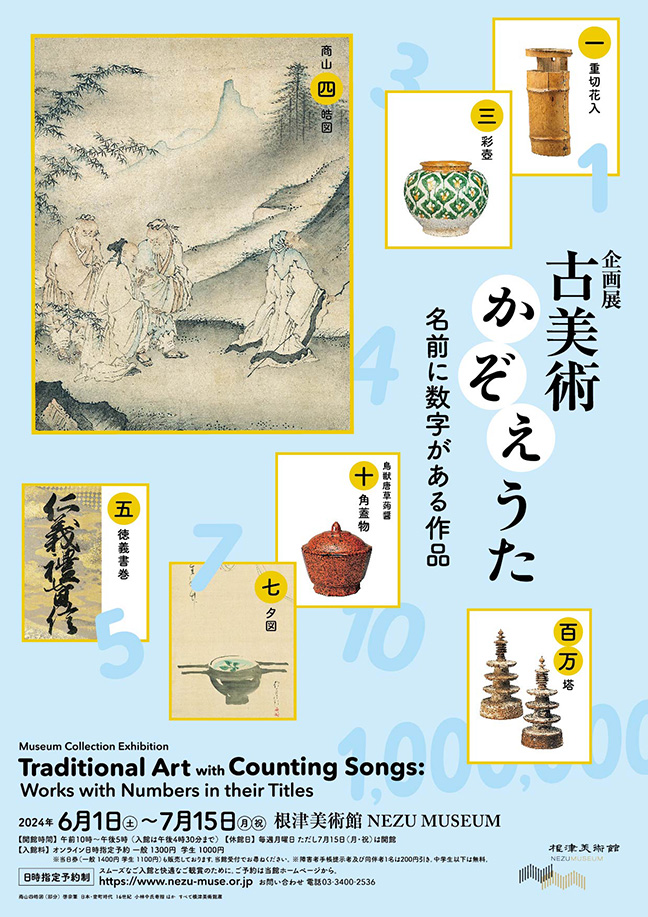
Museum Collection Exhibition
Traditional Art with Counting Songs
Works with Numbers in their Titles
Saturday, June 1 – Monday, July 15, 2024
Overview
| Dates | Saturday, June 1 – Monday, July 15, 2024 | |
|---|---|---|
| Closed | Mondays except July 15 | |
| Hours | 10 a.m. - 5 p.m.(last entry: 4:30 p.m.) | |
| General admission (On-line timed-entry tickets) | Adult 1300 yen, Student 1000 yen | |
| Gallery | 1/2 | |
We live surrounded by a deluge of numbers representing quantity, volume, order, or frequency. The titles of traditional works of art also often include numbers, meaningful numbers that concisely point to these works’ features. What these numbers signify is not, however, uniform. They may refer to shape or form, techniques and combinations, or customs and concepts. Paying attention to numbers in the titles of artworks can, thus, lead to a deeper understanding of these works. As you examine them, enhance your enjoyment by following the numbers, as if singing a counting song.
Gallery Exhibits
- National Treasure
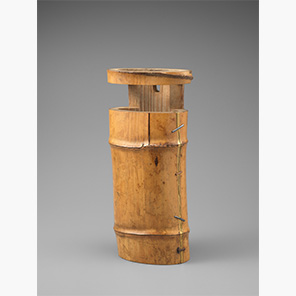
Vase with One Opening, Named Fujinami By Kobori Enshū
Bamboo vases may have one opening for flowers, a single cut, or two openings, called double cuts. Those numbers indicate the form of the vase.
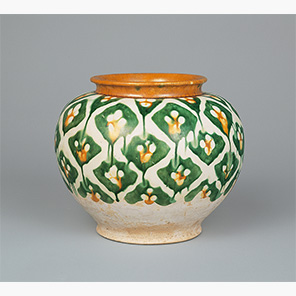
Jar with Three-Color Glaze
This jar, used as grave goods, is an example of Tang san-cai, three-color ware, fired at low temperatures and decorated with two or more differently colored glazes. The colors used on this jar are white, green, and brown. The numbers in the term “three-color ware” derive from the technique used in producing these ceramics.
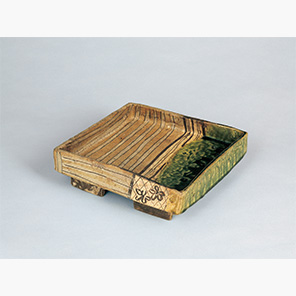
Four-sided Dish with Stripe Design
In the West, ancient vessels are almost entirely round or ovoid. In Japan, however, we find a greater variety of shapes. Besides four-sided squares and rectangles, there are also six, eight, and even twelve-sided shapes.
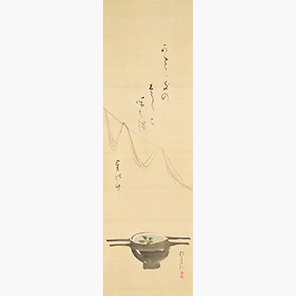
Decoration for Tanabata, on the 7th of the 7th month By Sakai Hōitsu
In this hanging scroll depicting an ornament for Tanabata, the Star Festival, celebrated on the seventh day of the seventh month, Sakai Hōitsu depicted decorations that signify prayers for improvement in sewing, calligraphy, and other arts and crafts. The numbers in the title refer to the only day of the year, according to Chinese legend, on which the Weaver Maid (Vega) and the Cowherd (Altair), otherwise separated by the Milky Way, can meet.
- TOP
- Exhibitions
- Works with Numbers in their Titles