Exhibitions
End
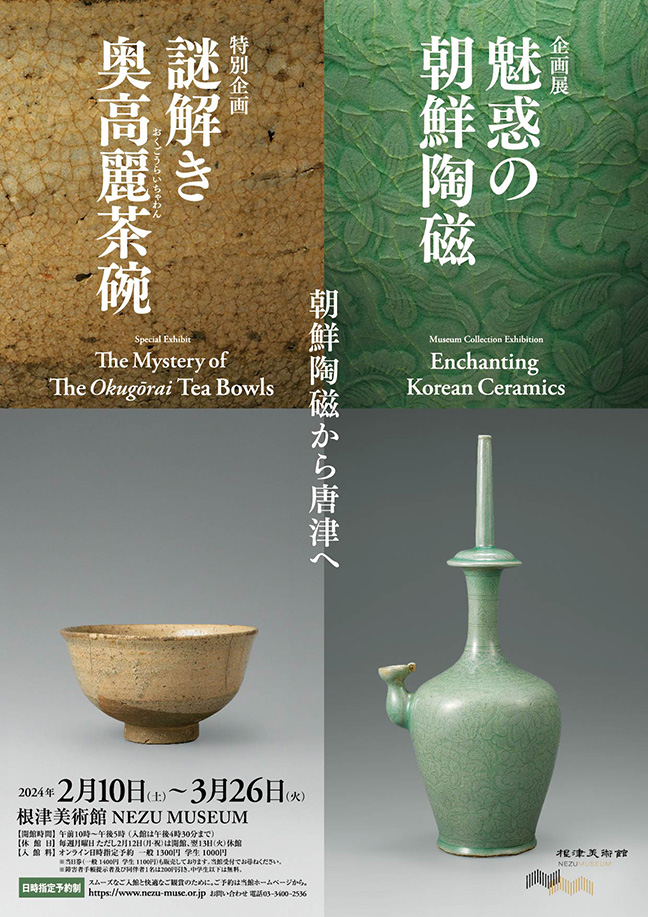
Museum Collection Exhibition
Enchanting Korean Ceramics
Special Exhibit
The Mystery of Okugōrai Tea Bowls
Saturday, Feburary 10, 2024 – Tuesday, March 26, 2024
Overview
| Dates | Saturday, Feburary 10, 2024 – Tuesday, March 26, 2024 | |
|---|---|---|
| Closed | Mondays | |
| Hours | 10 a.m. - 5 p.m.(last entry: 4:30 p.m.) | |
| General admission (On-line timed-entry tickets) | Adult 1300 yen, Student 1000 yen | |
| Gallery | 1/2 | |
【Gallery1】
Korean ceramics have long had a profound influence on ceramics in Japan, where they have been much loved. Beauty, purity, and powerful simplicity are incorporated in elegant deep gray-blue Goryeo celadons from the twelfth century, the Kōrai-chawan group tea bowls that won great popularity among men of tea in the sixteenth and seventeenth centuries, and the Buncheong and white porcelain wares from the fifteenth to the eighteenth centuries. Lovers of ceramics in Japan have consistently collected all of these wares. This exhibition surveys the history of Korean ceramics, primarily through works from our collection, and examines their fascination. Won’t you try immersing yourself in the captivating world of Korean ceramics?
【Gallery2】
Okugōrai-chawan group tea bowls were made in the Hizen region of Kyushu, in what is now the area around Karatsu, Saga prefecture. These wares, which closely emulate Korean ceramics, have been appreciated in the world of tea from the latter half of the Edo period on and were highly regarded among connoisseurs during the postwar Kokaratsu (Old Karatsu) boom. Yet the source of the name okugōrai, the location of the kilns, and the definition of okugōrai-chawan are among the many remaining mysteries about these wares.
Continuing from the Korean ceramics in Gallery 1, which include kōrai-chawan tea bowls that were okugōrai’s models, here we have tried to identify okugōrai tea bowls as “Karatsu ware tea bowls for tea gatherings,” given their characteristics. Have we solved the mystery? Please visit this gallery and see what you think.
Gallery Exhibits
- Important Cultural Property
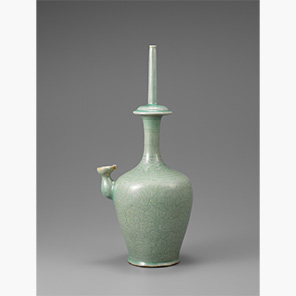
Ewer with Lotus Scroll Design
For your appreciation: An ultra-famous Goryeo celadon .
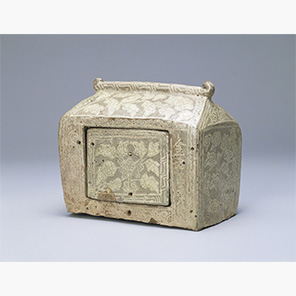
Buddhist Cabinet with Peony Design
White clay inlay makes peonies bloom on the doors and roof.
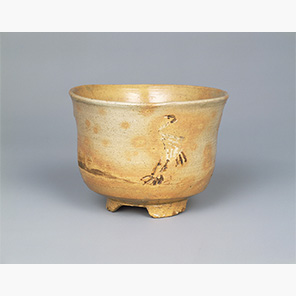
Tea Bowl with Crane Design
A Kōrai-chawan tea bowl commissioned from Pusang, its design based on a painting by Tokugawa Iemitsu, the third Tokugawa shogun .
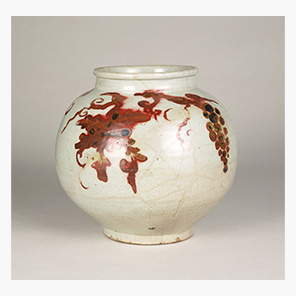
Jar with Grape Design
Stunning red grapes on a white porcelain jar from a Gwangju official kiln.
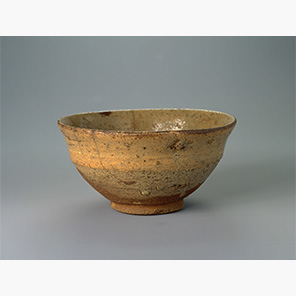
- Important Cultural Property
Tea bowl, Named Sanpou
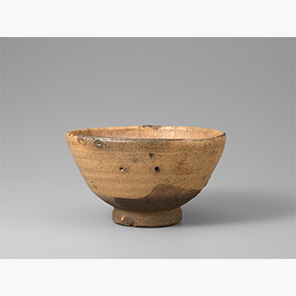
Tea bowl, Named Miyamaji
Matsudaira Fumai, a daimyo tea master, owned this tea bowl, regarded as a “famous product.”
- TOP
- Exhibitions
- Enchanting Korean Ceramics