Exhibitions
Upcoming
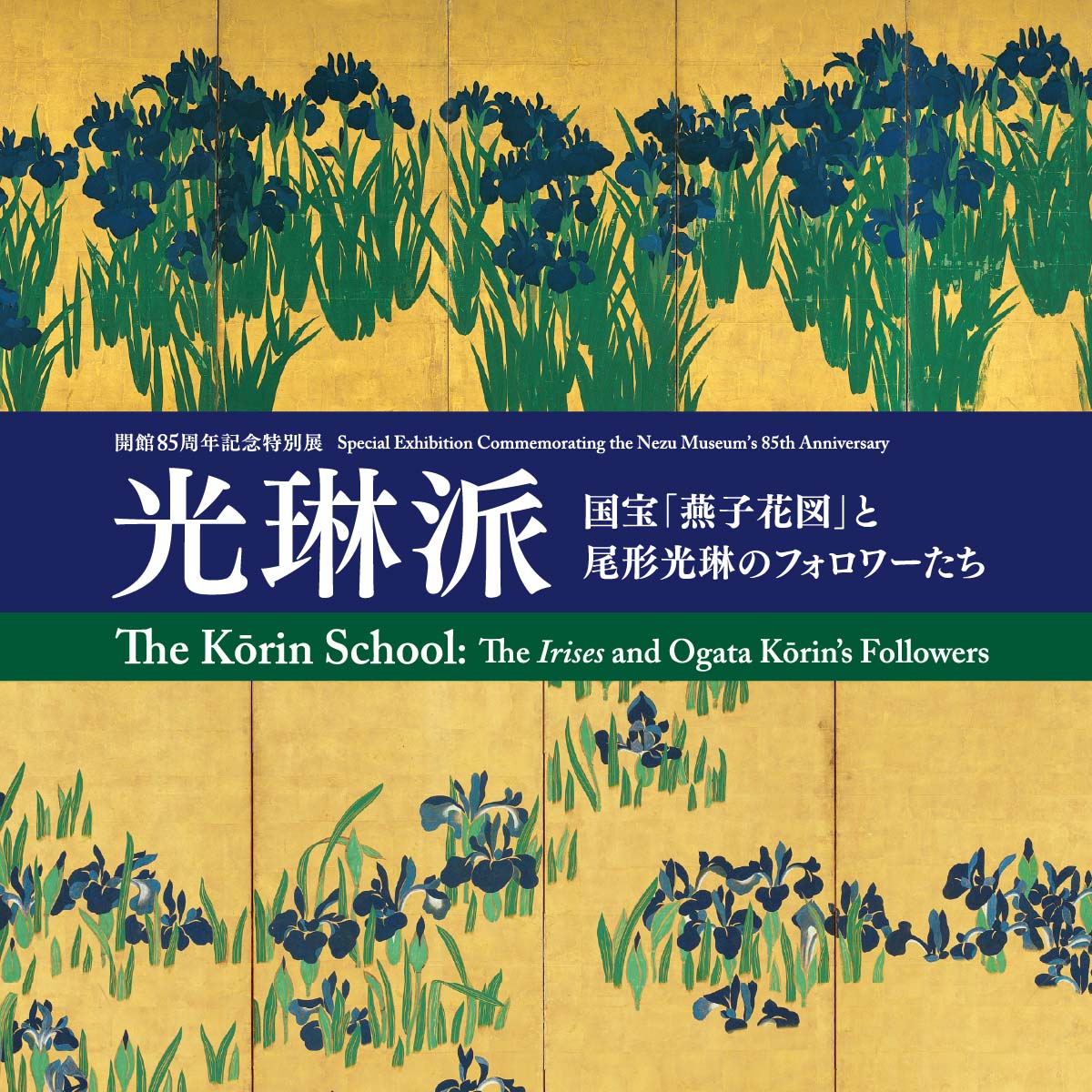
Special Exhibition Commemorating the Nezu Museum’s 85th Anniversary
The Kōrin School: The Irises and Ogata Kōrin’s Followers
Saturday, April 11 – Sunday, May 10, 2026
Overview
| Dates | Saturday, April 11 – Sunday, May 10, 2026 | |
|---|---|---|
| Closed | Closed on Mondays, except May 4. | |
| Hours | 10 a.m. - 5 p.m.(last entry: 4:30 p.m.) 10 a.m. - 7 p.m. May 5-10 (last entry: 6:30 p.m.) |
|
| General admission (On-line timed-entry tickets) | Timed-entry ticket (online) Adult : 1800 yen Student* : 800 yen *University students and above with valid student ID; Highschool and younger students with valid student ID will be admitted free of charge. Same-day tickets: plus 200 yen on the above prices. |
|
| Gallery | 1, 2, 5 | |
Renowned for its design-oriented style, the Rimpa school has left an enduring mark on the history of Japanese painting. The school is often described as having unfolded across time through a lineage of painters who admired and inherited their predecessors’ artistic styles—from Tawaraya Sōtatsu (dates unknown), to Ogata Kōrin (1658–1716), and later to Sakai Hōitsu (1761–1829). However, the formation of the art of Rimpa was not the achievement of these three figures alone.
Ogata Kōrin, the painter of the National Treasure Irises Screens, had a number of followers connected to him both directly and indirectly. Among them, Watanabe Shikō, who supported his master’s production with exceptional skill, and Kenzan, the potter who collaborated with his elder brother, Kōrin, to produce works of remarkable design, are well known. By contrast, opportunities to encounter the works by Fukae Roshū, also a follower of Kōrin, or Tatebayashi Kagei, who studied under Kenzan and came to be regarded as “Kōrin III,” are exceedingly rare today.
Featuring also works returning to Japan for this occasion from the Cleveland Museum of Art in the United States, the exhibition offers a comprehensive overview of the little-known “Kōrin School” and sheds new light on the history of Rimpa.
Gallery Exhibits
- National Treasure
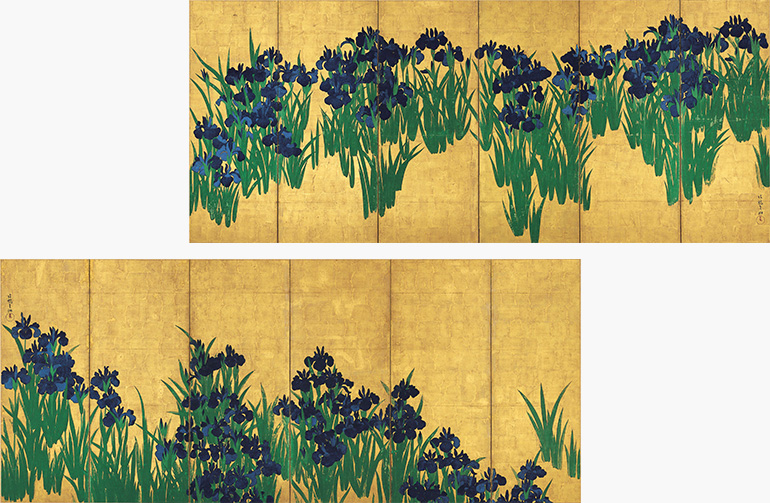
Irises
By Ogata Kōrin
Against the gold ground that covers the entire surface, clusters of irises stand out vividly with their varied azurite blue tones and malachite green. Based on Kōrin’s calculated approach that highlights the contrast and balance between the right and left screens, the irises are arranged in a powerfully rhythmic order. Equally noteworthy is the plump modeling of the petals. Created about a decade after Kōrin began painting in earnest, this pair of folding screens represents the first artistic peak of the painter.
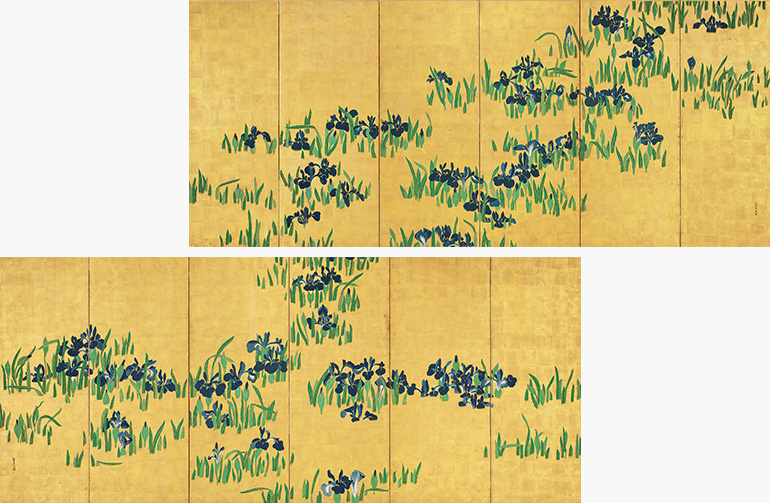
Irises
By Watanabe Shikō
The subject of irises alone against a full gold ground clearly derives from Kōrin. Nevertheless, Shikō’s effort to articulate the forms of each individual blossom showcases both his skills in painting from life and his background serving the learned courtier Konoe Iehiro. The omission of the lower portions of the plants suggests the presence of mist. Such evocation of the humid atmosphere and expansive spatial ambiance of early summer watersides against a decorative gold surface is strikingly innovative.
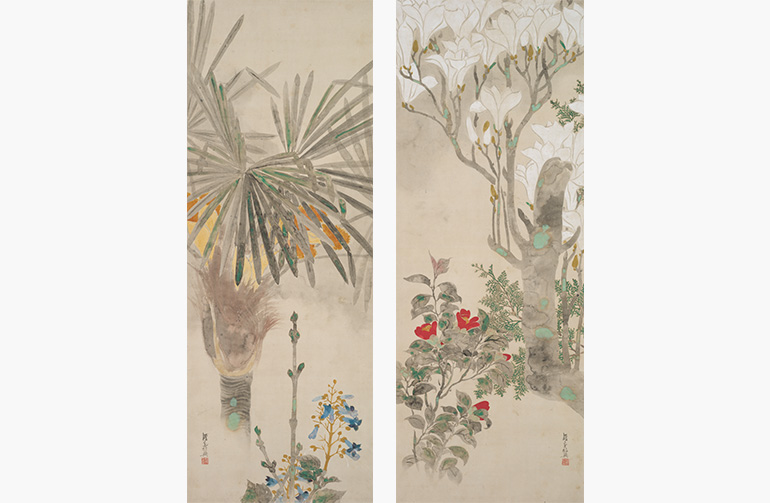
- Important Art Object
Magnolia and Palm Tree
By Watanabe Shikō
The right hanging scroll from this diptych depicts a white magnolia tree alongside camellias and a hinoki cypress, while the left shows a palm tree with yellow blossoms and a paulownia tree. Executed primarily in medium-light ink with extensive use of the tarashikomi (puddling) technique, these paintings are enlivened with blossoms in white, red, yellow, and blue. The flowering palm motif also appears in Konoe Iehiro’s True Depictions of Flowers and Trees (J: Kaboku shinsha), which indicates Shikō’s close relationship with Iehiro. This diptych originally belonged to the Konoe family. Also noteworthy is that the visual weight is placed high in the overall composition, but at slightly different levels in the left and right scrolls.
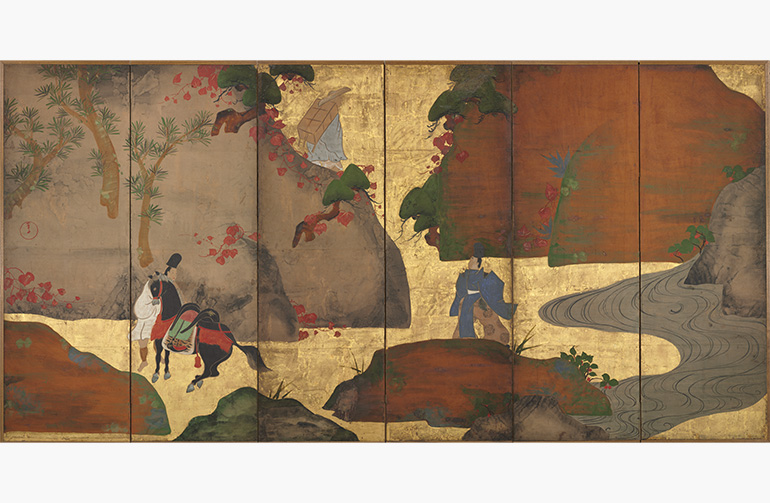
Ivy Lane
By Fukae Roshū
This painting illustrates the ninth episode of The Tales of Ise, in which a man traveling eastward over Mount Utsu encounters an itinerant monk whom he had once known. He then entrusts the monk with a poem intended for a lover he left behind in the capital. The scene of the man seeing off the monk follows the precedents seen in works by Kōrin and Tawaraya Sōtatsu. In particular, the composition of broad color planes forming the mountains against a gold ground indicates the painter’s deep understanding of Sōtatsu’s style. Among the three extant works of the same subject by Fukae Roshū, this painting appears to be the earliest.
Concurrent Exhibitions
During “The Kōrin School: The Irises and Ogata Kōrin’s Followers" Saturday, April 11 – Sunday, May 10, 2026)
Gallery 2
The Kōrin School: The Irises and Ogata Kōrin’s Followers (cont'd)
Following Gallery 1, please enjoy the works by Fukae Roshū and Tatebayashi Kagei.
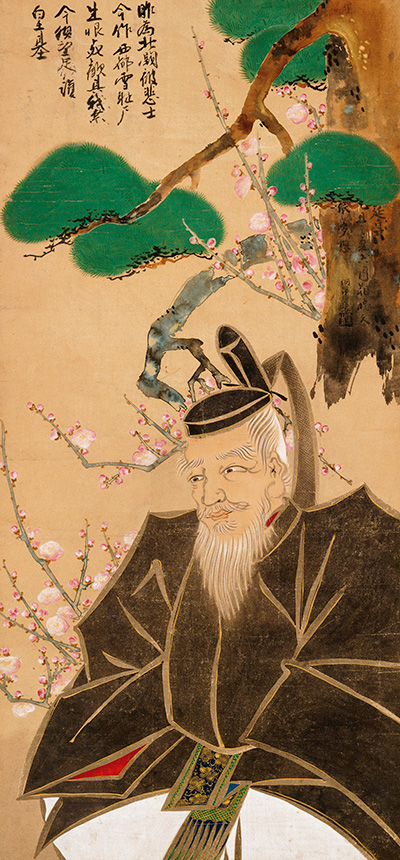
- Painting
God Tenjin
By Tatebayashi Kagei
Gallery 3
The Allure of Buddhist Art: Buddhist Sculptures Created in the Early Modern Period
Gallery 3 presents a Buddhist sculpture from the late medieval period (15th to 16th century) and masterpieces of early modern Buddhist sculpture.
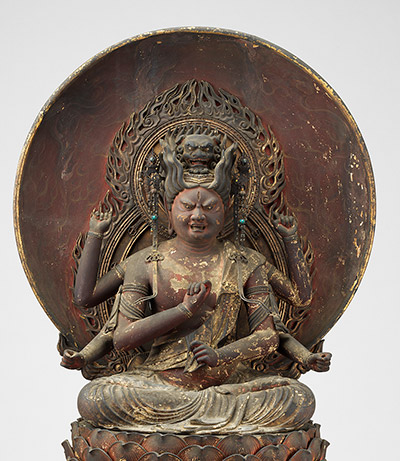
- Sculpture
Seated Aizen-myōō (Rāgarāja)
Gallery 4
Ancient Chinese Bronzes
The Nezu Museum collection of bronzes is world-renowned, and particularly strong in the area of late Shang (17th to 11th centuries BC) dynasty vessels, the pinnacle production period of this medium.
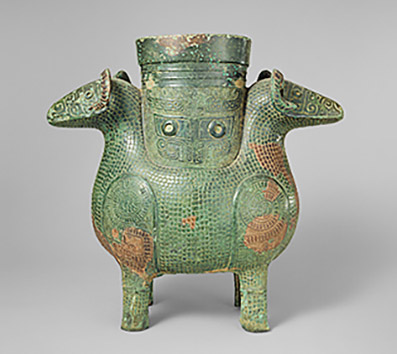
- Archaeological Artifacts / Mirror
- Important Cultural Property
Double-Ram Zun
Gallery 5
The Kōrin School: The Irises and Ogata Kōrin’s Followers (cont'd)
Following Gallery 2, please have a look at Ogata Kenzan’s works.
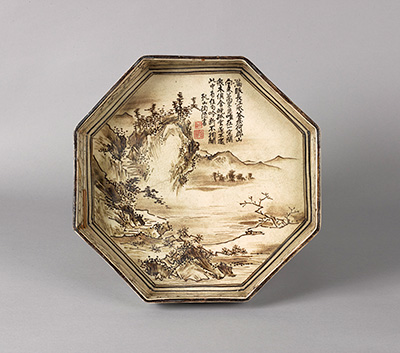
- Ceramics
Octagonal Dish with Landscape Design
By Ogata Kenzan
Gallery 6
Tea in Early Summer
The fifth day of the fifth lunar month marks the beginning of summer. In keeping with the season’s refreshing spirit, tea gatherings shift to summer utensils that refresh the mind of the host and guests.
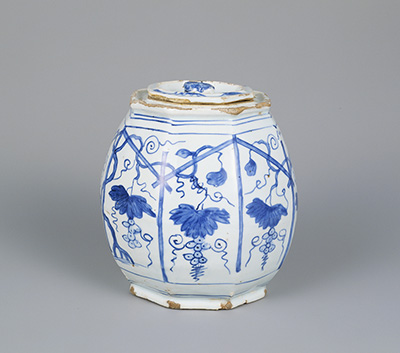
- Ceramics
Fresh Water Container with Grape Design Jingdezhen ware, ko-sometsuke type
Special Case
Decorated Clock
This splendid Qing dynasty clock, a favorite of the Qianlong Emperor (1711-1799), is not to be missed.
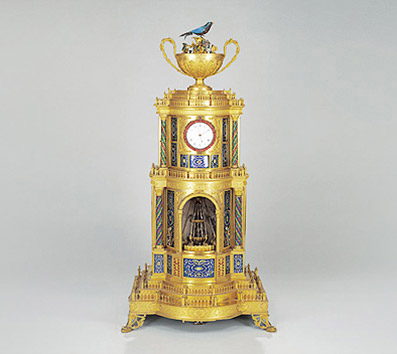
- Decorated Clock
Clock Decorated with a Bird on a Cup
- TOP
- Exhibitions
- Upcoming